
Licensed vs. Offshore: The 2026 Security Audit
 Available in US

The sports betting world splits into two fundamentally different universes, and most bettors don’t fully understand the implications until they’ve already committed their money to one side or the other. On one side, you have regulated bookmakers operating under strict governmental oversight within your jurisdiction. On the other, offshore operators based in gambling-friendly countries serving customers globally without being bound by your local laws. This isn’t just a legal technicality it’s a decision that will shape every aspect of your betting experience, from how much you can wager to whether you’ll still have an account next month if you start winning consistently.
The conventional wisdom suggests the choice is simple: regulated equals safe, offshore equals risky. But spend time talking to serious bettors, and you’ll quickly discover that reality is far more nuanced. Professional bettors often prefer offshore operators despite the lack of local legal protection, while recreational players sometimes find themselves frustrated with regulated bookmakers that seemed perfect on paper. The fundamental question isn’t which option is objectively better it’s which option aligns with your specific betting profile, risk tolerance, and long-term goals.
This guide examines the actual differences between licensed and offshore bookmakers beyond the surface-level distinctions you’ll find on most comparison sites. We’re going to dig into how licensing actually works in practice, what consumer protections you’re really getting or giving up, how the betting experience differs between the two models, and most importantly, who benefits from each approach. By the end, you’ll understand not just the theoretical differences but the practical implications that will affect your betting career from day one.
The sports betting landscape has evolved dramatically since the US Supreme Court struck down PASPA in 2018, opening the floodgates for state-by-state legalization. But even with dozens of states now offering legal sports betting, offshore bookmakers continue thriving and attracting American customers. Understanding why that remains the case despite expanded legal options reveals everything you need to know about the strengths and weaknesses of each model.
Risk Mitigation: Protecting Your Betting Capital in 2026
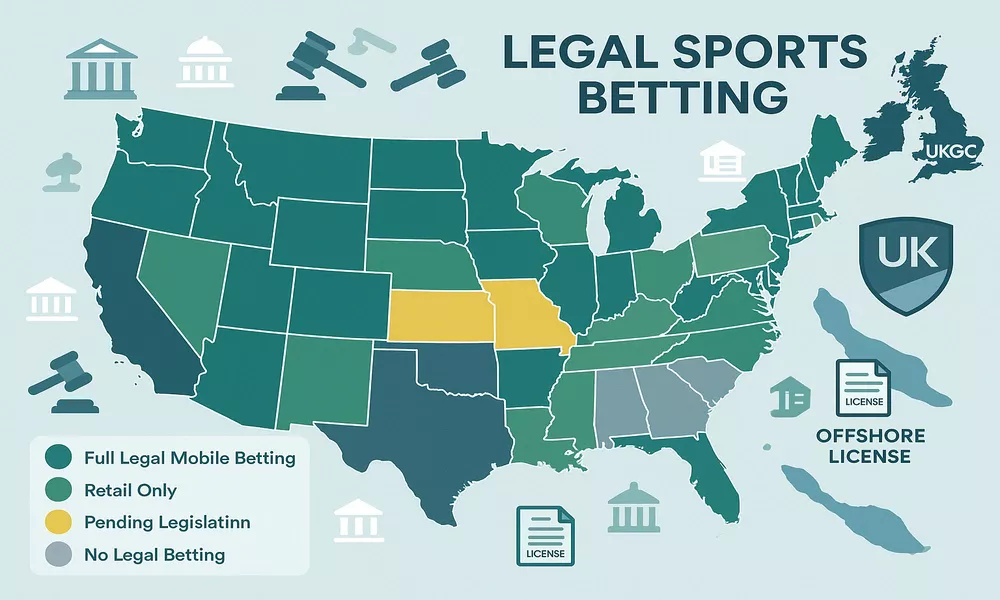
The first thing to grasp is that “licensed” and “offshore” aren’t synonymous with “legal” and “illegal” in the way most people assume. The reality is considerably more complex, starting with the fact that betting laws vary dramatically by jurisdiction. What’s perfectly legal in one state might be prohibited fifty miles away across a border. What’s considered offshore from an American perspective might be fully regulated domestic betting from a European viewpoint.
In the United States, regulated sports betting exists only where individual states have passed legislation authorizing it and established licensing frameworks. As of 2026, over thirty states allow some form of legal sports betting, though the specifics vary wildly. Some states permit only retail betting at physical locations, others allow mobile betting statewide, and some restrict online betting to specific venues or tribal lands. Each state that legalizes sports betting establishes its own regulatory body, licensing requirements, tax structures, and operational rules. A bookmaker like DraftKings or FanDuel must obtain separate licenses for each state where they operate, comply with that state’s specific regulations, and typically pay substantial licensing fees plus ongoing taxes on revenue.
The application process in states like New Jersey or Pennsylvania involves extensive documentation that can take months to prepare and submit. Operators must prove financial stability with millions in liquid assets, submit to comprehensive background checks on all key personnel and significant investors, demonstrate that technology systems meet rigorous security and fairness standards, establish comprehensive responsible gambling protocols, and provide detailed business plans showing how they’ll operate sustainably while complying with all regulations. The process isn’t just expensive in terms of application fees reaching hundreds of thousands of dollars it also requires substantial legal resources to navigate the complex regulatory requirements, and there’s no guarantee of approval even after investing all this time and money.
Once licensed, operators face ongoing oversight that’s far more involved than most bettors realize. State gaming commissions conduct regular audits to ensure financial compliance and verify that customer funds remain properly segregated from operational expenses. Technology systems undergo periodic testing to confirm random number generators function properly, odds-setting algorithms operate fairly without manipulation, and security measures adequately protect customer data from breaches. Compliance reviews examine whether operators follow advertising restrictions that prevent marketing to minors or problem gamblers, implement responsible gambling measures effectively, and handle customer complaints appropriately. Violating regulations can result in fines reaching millions of dollars, mandatory operational changes, or in severe cases, license suspension or revocation. The New Jersey Division of Gaming Enforcement has demonstrated they take enforcement seriously by issuing substantial penalties even to major operators for compliance failures.
Offshore bookmakers, conversely, obtain their licenses from gambling-friendly jurisdictions outside the United States most commonly Curacao in the Caribbean, Costa Rica in Central America, Panama, or Malta in the European Union. These operators then accept customers from around the world, including American bettors in states where local sports betting may not be legal or where regulated options don’t exist. The legal framework here gets murky fast because federal law in most jurisdictions focuses on operators rather than individual bettors. The Wire Act from 1961 prohibits transmitting wagers across state lines, but its application to modern internet betting remains disputed in courts. The Unlawful Internet Gambling Enforcement Act from 2006 restricts payment processors from handling transactions for illegal gambling but doesn’t explicitly criminalize the act of placing bets yourself.
What this means practically is that using offshore bookmakers occupies a legal gray area for most American bettors. There’s no specific federal law stating that an individual commits a crime by placing a bet with an offshore operator. Some states have passed laws explicitly prohibiting residents from using offshore bookmakers, others remain silent on the issue, and enforcement against individual bettors is virtually nonexistent authorities focus their limited resources on prosecuting operators rather than customers. The legal risk sits primarily with the operators themselves, not the customers placing bets. That said, operating in a gray area isn’t the same as operating with clear legal protection, and that distinction matters significantly when disputes arise or if you win substantial amounts.
The situation differs entirely in other countries where sports betting has longer legal history. The United Kingdom has a mature, well-regulated gambling market where operators must hold UK Gambling Commission licenses to legally serve British customers. Many of the bookmakers Americans consider offshore are actually fully licensed, heavily regulated operators in their home markets. A British bettor using Bet365 is using a domestically licensed bookmaker operating under strict UKGC oversight just as much as an American using DraftKings in New Jersey is using a state-licensed operator. European Union countries have their own regulatory frameworks, with some maintaining tight national control over gambling while others recognize licenses from other EU member states.
Understanding your local legal landscape is crucial before choosing between licensed and offshore options. In states with legal sports betting and multiple regulated operators available, using regulated bookmakers is unquestionably the safer legal choice with clear protections. In states without legal options where online betting remains prohibited or unregulated, offshore bookmakers provide the only avenue for online sports betting, and millions of Americans use them without facing legal consequences. The question in those situations becomes not whether it’s technically legal in some academic sense, but whether the trade-offs involved in using offshore operators align with your personal priorities and comfort level with operating in legally ambiguous territory.
How Licensing Actually Works
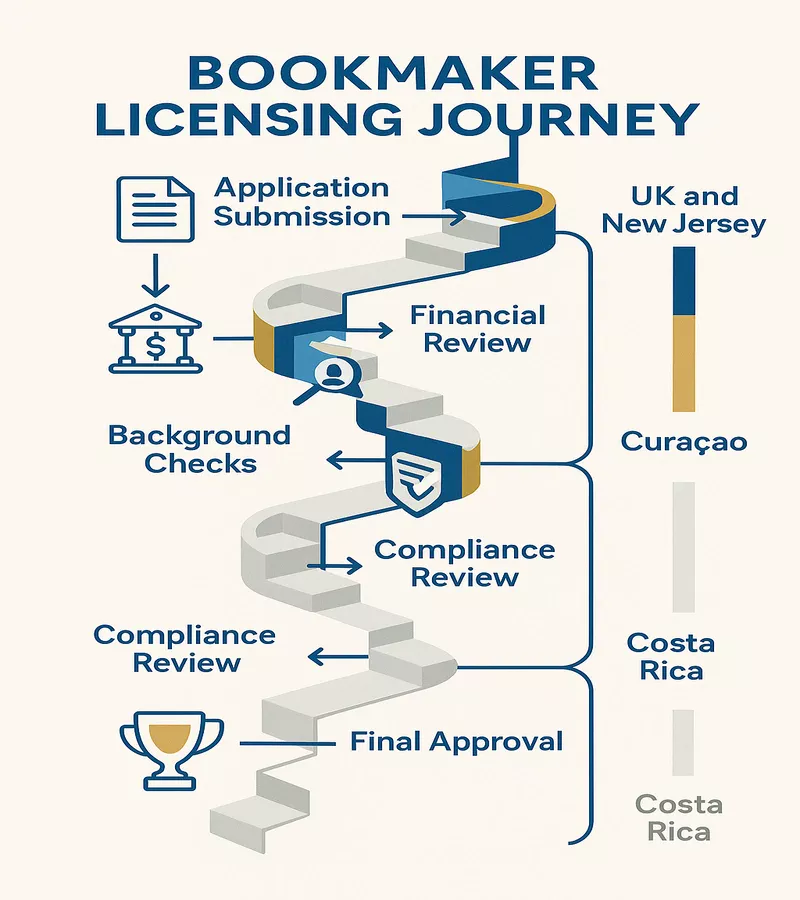
The licensing process for bookmakers is far more involved than most bettors realize, and understanding what different licenses actually require helps clarify what protections they provide or don’t provide. When someone casually says a bookmaker is licensed, that single word conceals a massive range of regulatory oversight depending on which authority issued the license and what requirements they enforce.
Regulated bookmakers in the United States face some of the most stringent requirements globally. The application process in New Jersey, which pioneered legal sports betting after PASPA fell and set standards many other states followed, requires operators to submit detailed business plans demonstrating how they’ll operate profitably while complying with all regulations. They must prove financial stability with substantial liquid assets available to cover customer balances even during worst-case scenarios like extended losing streaks for the house. Background checks extend not just to company officers but to major investors and anyone with significant financial interest in the operation, screening for criminal history, ties to organized crime, or integrity concerns. Technology systems undergo extensive security audits to verify they meet standards for protecting customer data, preventing unauthorized access, and implementing safeguards against underage gambling.
The costs involved are substantial enough to create barriers to entry that partly explain why the legal US sports betting market has consolidated around a handful of major players. Application fees alone run into hundreds of thousands of dollars per state. Legal fees for preparing comprehensive applications and navigating the regulatory process add significantly more. The time investment is measured in months from initial application submission to receiving approval and going live. These high barriers mean smaller operators often struggle to compete, giving advantages to well-capitalized companies like DraftKings, FanDuel, BetMGM, and Caesars who have resources to navigate multiple state licensing processes simultaneously while maintaining operations.
The UK Gambling Commission operates with similarly rigorous oversight that many industry observers consider the gold standard globally for consumer protection and fair dealing requirements. UKGC licenses require operators to maintain segregated customer funds in separate bank accounts that legally cannot be touched for operational expenses, ensuring that even if the bookmaker faces bankruptcy, customer deposits remain protected and available for withdrawal. They must implement comprehensive responsible gambling tools including mandatory deposit limits, reality checks that interrupt play to show time and money spent, and self-exclusion programs. Customer verification must happen before allowing any deposits, preventing underage gambling and ensuring operators know exactly who their customers are for anti-money-laundering compliance. Regular independent audits by approved testing laboratories verify that all systems operate fairly and all requirements are met continuously.
The UKGC’s enforcement record demonstrates they take violations seriously and impose meaningful consequences that ensure operators maintain high standards. In recent years, they’ve issued fines totaling tens of millions of pounds against major operators for failures in anti-money-laundering procedures that allowed suspicious transactions to go unquestioned, inadequate protection of vulnerable customers who showed obvious problem gambling behaviors, and other compliance breaches. These aren’t token slaps on the wrist they represent substantial financial penalties calculated to hurt enough that operators invest properly in compliance systems. The UKGC also operates shared databases for self-exclusion across the entire industry, meaning if you ban yourself from one UKGC-licensed operator due to gambling problems, you’re automatically excluded from all of them, preventing the common pattern where problem gamblers simply move to another bookmaker when restricted.
Then we get to offshore licenses, and the picture changes dramatically in terms of regulatory rigor and oversight intensity. Curacao eGaming is probably the most common license you’ll see displayed on offshore bookmakers serving American customers. The Curacao government issues master licenses to a small number of companies, which then sublicense to individual operators in a two-tier system where the master license holder has some responsibility for monitoring sublicensees. Obtaining a Curacao sublicense is far easier and less expensive than getting licensed in New Jersey or by the UKGC. The regulatory oversight is real in the sense that there are requirements and some monitoring happens, but it’s minimal compared to tier-one jurisdictions.
Curacao licenses require operators to maintain some financial reserves as protection against insolvency, implement basic security measures to protect customer data from obvious breaches, and follow certain operational standards, but enforcement is far less rigorous and comprehensive than top-tier regulators. Customer fund segregation may not be mandated under Curacao licensing frameworks, meaning deposits might sit in the same accounts operators use for business expenses. Responsible gambling tools might be suggested as best practices but not strictly required, leaving operators free to implement minimal protections or none at all if they choose. Dispute resolution is often handled by the master license holder rather than government authorities, and the quality and independence of these mediation services varies significantly between different master license holders.
Costa Rica represents an even lighter regulatory touch that’s barely regulation at all in practical terms. Costa Rica doesn’t actually issue gambling-specific licenses in any meaningful sense operators receive standard business licenses that allow them to operate data processing companies or similar businesses. This provides a legal framework for the business entity to exist, operate servers, employ staff, and conduct commerce, but it’s not gambling regulation involving governmental oversight of customer treatment. There’s virtually no oversight of how these operators treat customers, what security measures they implement to protect data and funds, whether they maintain adequate reserves to pay winners, or whether they process withdrawals fairly and promptly. The reputation of Costa Rica-licensed bookmakers depends entirely on the individual operator’s business practices and track record rather than regulatory enforcement or governmental monitoring.
Understanding these distinctions is crucial when evaluating which bookmakers to trust with your money. A Curacao-licensed offshore operator isn’t necessarily untrustworthy or dishonest many have operated fairly for decades and built solid reputations through consistently treating customers well and paying out promptly even when it hurts their bottom line but they’re not subject to the same intensive scrutiny and enforcement as UKGC or New Jersey licensed operators. The regulatory safety net is demonstrably thinner or effectively nonexistent. When things go wrong or disputes arise, your recourse is limited to the operator’s customer service and whatever mediation their license provides, rather than having a government agency you can appeal to with real enforcement power and authority to compel fair resolution.
Consumer Protection: The Core Difference

The most significant distinction between licensed and offshore bookmakers boils down to what happens when something goes wrong and eventually, something will go wrong in any business relationship involving money. Consumer protection mechanisms differ so dramatically between the two models that they essentially create different risk profiles for bettors.
Regulated bookmakers operating under licenses from serious gambling authorities provide multiple layers of protection that work together to safeguard customers. Start with fund segregation requirements that are strictly enforced through regular audits customer deposits must be held in separate accounts completely isolated from operational funds that the company uses for expenses, salaries, and business operations. If the bookmaker faces financial difficulties, poor business performance, or even bankruptcy, customer funds remain legally protected and available for withdrawal because they’re segregated by law. This isn’t just theoretical protection written in regulations authorities regularly audit these segregated accounts to verify compliance and confirm that customer balances are fully protected at all times.
Beyond fund protection, regulated bookmakers must implement extensive responsible gambling measures that are mandated by licensing conditions rather than optional features operators choose to provide if they feel like it. Self-exclusion programs allow players to ban themselves from betting for specified periods or permanently, and in mature markets like the UK, this extends across all licensed operators through shared regulatory databases maintained by the gambling commission. If you self-exclude from one UKGC-licensed bookmaker due to problem gambling concerns, you’re automatically excluded from all of them industry-wide, preventing the common destructive pattern where problem gamblers simply move to another operator when they get banned or restricted from one.
Deposit limits let you cap how much you can deposit daily, weekly, or monthly, preventing impulsive betting beyond your financial means during emotional moments. Reality checks interrupt your betting session at preset intervals to show you exactly how long you’ve been playing and how much you’ve wagered and lost, forcing awareness of time and money spent that’s easy to lose track of when absorbed in betting. Links to gambling addiction resources like GamCare in the UK, the National Council on Problem Gambling in the US, and Gamblers Anonymous are prominently displayed throughout the platform. Customer service staff receive specific training to identify problem gambling behaviors like chasing losses aggressively or betting amounts disproportionate to deposit patterns, and they’re required to intervene appropriately when they notice concerning warning signs.
Dispute resolution through regulated bookmakers follows established formal processes with government oversight providing accountability and recourse beyond the operator’s discretion. If you have a dispute about a bet you believe was graded incorrectly based on the stated rules, a withdrawal that hasn’t been processed within advertised timeframes without explanation, questionable application of terms and conditions that seems inconsistent with how they’re written, or any other issue where you feel the operator treated you unfairly, you first go through the bookmaker’s internal complaints process. Most legitimate operators resolve issues at this stage because they understand that unresolved complaints can escalate to regulators who will scrutinize their practices, and they want to maintain good standing.
If the internal process doesn’t resolve things satisfactorily and you genuinely believe the operator treated you unfairly or violated regulations, you can escalate complaints to the regulatory authority. The UKGC operates a formal Alternative Dispute Resolution service where they investigate complaints seriously, review documentation from both parties objectively, and can compel operators to provide comprehensive justification for their decisions or rectify unfair practices. US state gaming commissions accept complaints through official channels and investigate with authority to impose penalties on operators that violate regulations or treat customers unfairly in ways that breach licensing conditions.
Now contrast this with offshore bookmakers, where consumer protection depends almost entirely on the operator’s reputation and business interest in maintaining it rather than enforced regulatory requirements backed by government authority. Fund segregation isn’t typically mandated by Curacao or Costa Rica licensing frameworks. Your deposits might sit in the same accounts the bookmaker uses for operational expenses, office rent, staff salaries, marketing costs, and other business expenditures, meaning financial difficulties could potentially threaten customer funds if the operation becomes insolvent or faces cash flow problems. Most reputable offshore operators with established track records maintain adequate reserves and treat customer funds appropriately as a matter of sound business practice because they understand that destroying their reputation would destroy their business model and future earning potential, but this relies entirely on self-regulation and enlightened self-interest rather than enforced legal requirements with governmental oversight ensuring compliance.
Always use a licensed sportsbook to ensure your consumer rights are fully protected.
Dispute resolution represents perhaps the sharpest and most consequential practical difference between regulated and offshore models. If you have a problem with an offshore bookmaker a bet you believe should have won but was graded as a loss, a withdrawal that isn’t being processed without clear explanation, an account suddenly closed with your balance confiscated based on alleged terms violations you don’t believe you committed your recourse is fundamentally limited and depends entirely on the operator’s willingness to treat you fairly. You can escalate within their customer service structure, hoping to reach a supervisor or manager with more authority and discretion to resolve issues fairly. You can complain publicly on betting forums hoping reputation pressure encourages fair resolution. Some offshore books participate in mediation services, though effectiveness varies wildly. As a last resort, you could theoretically pursue legal action in their jurisdiction, but this is prohibitively expensive and impractical.
The Betting Experience Comparison
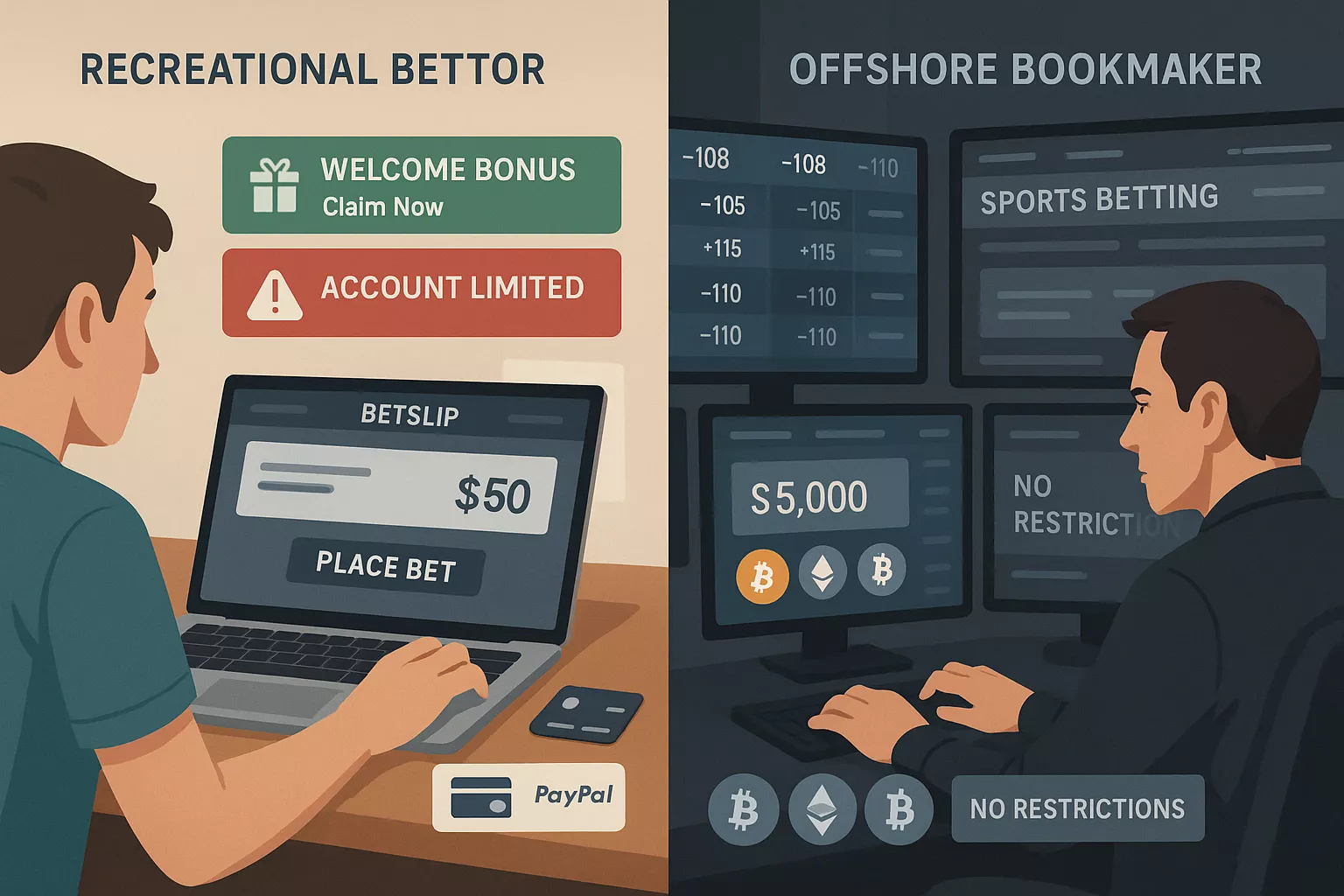
Beyond legal frameworks and consumer protections, the day-to-day betting experience differs substantially between licensed and offshore bookmakers in ways that significantly impact whether you’ll be satisfied with your choice.
Account longevity for winning bettors represents perhaps the most dramatic practical difference. Regulated bookmakers serving recreational markets fundamentally operate on business models built around customer losses rather than balanced books with profit from vig. They spend millions on television advertising and promotional campaigns. They offer generous welcome bonuses that cost substantial money. They pay significant licensing fees and taxes. They need to extract enough profit from losing customers to cover all these costs plus generate returns for investors. Winning customers who consistently take money out are liabilities that reduce profitability.
Most regulated books consequently limit or close accounts showing consistent profitability with uncomfortable aggression. This doesn’t necessarily mean winning one bet triggers restrictions immediately. But if you’re consistently beating closing lines, showing positive expected value patterns, targeting soft markets, or simply winning more than you lose over sustained periods, restrictions typically come faster than casual bettors expect. Your maximum bet might drop from five hundred to twenty dollars seemingly overnight. Certain markets become unavailable. Eventually, you might face complete account closure.
The restriction speed at many regulated bookmakers often genuinely shocks bettors who assumed they were dealing with legitimate businesses. You might win a few hundred dollars over your first month, suddenly receive an email saying your account is under review, and discover you can only bet tiny amounts. There’s rarely meaningful recourse because terms and conditions give operators broad discretion.
Offshore bookmakers serving sharp bettors operate under fundamentally different business models. Books like Pinnacle, Bookmaker, and Heritage Sports deliberately built their businesses around accepting large wagers from professional bettors. Their profit comes from the vig on balanced books rather than net customer losses. They use sharp action to set accurate lines, welcome professional-level betting, then profit from volume on both sides. For these operators, winning bettors aren’t liabilities they’re valuable contributors whose action improves the product.
You might bet fifty thousand on a single NFL game, show consistent profitability over months, and never face restrictions because the bookmaker wants your action. This doesn’t mean you can never be limited offshore, but reputable offshore books serving professional markets welcome winning action far more than regulated operators.
Betting limits differ dramatically. Most regulated bookmakers impose relatively modest limits a few thousand on major markets, less on props. Offshore bookmakers serving professional markets offer dramatically higher limits five figures on major sports is standard, six figures on biggest events isn’t unusual.
Odds quality consistently favors offshore bookmakers. Pinnacle routinely offers margins around two percent on major markets compared to five to seven percent at many regulated books. Heritage Sports offers reduced juice at minus-108. This difference compounds enormously over volume. Betting consistently at minus-108 versus minus-110 changes your breakeven rate from 52.4 percent to roughly 51.9 percent. Over thousands of bets, this translates to massive profit differences potentially tens of thousands for high-volume bettors.
Market variety shows interesting differences. Regulated bookmakers face restrictions on what they can legally offer. Many US states prohibit props on college players. Offshore bookmakers face no such restrictions, offering comprehensive markets on college sports, international leagues, political events, and novelty props.
Payment processing reveals distinct patterns. Regulated bookmakers work within traditional banking systems, offering credit cards, PayPal, and bank transfers. Deposits are instant, withdrawals process within days. Offshore bookmakers lean heavily on cryptocurrency. Many offshore books process crypto withdrawals within hours, offering dramatically faster access than most regulated operators.
Security also depends on how you handle your funds, so check which payment methods and withdrawals are the fastest.
Tax Implications
Tax treatment differs fundamentally and can represent thousands or tens of thousands of dollars annually for successful bettors.
Regulated bookmakers in the United States are required to report your winnings to the IRS through W-2G forms when you win certain amounts. The specific thresholds depend on wager type and odds, but generally winnings of six hundred dollars or more at certain odds trigger reporting. Many states require operators to report all customer winnings regardless of federal thresholds. Your annual winnings from regulated bookmakers are systematically documented and shared with tax authorities automatically. You’ll receive copies, and the IRS receives identical copies.
State taxes add complexity. Beyond federal income tax, many states impose additional taxes on gambling winnings. Some states tax gross winnings without allowing full deduction of losses, creating harsh implications where you could owe taxes on winning sessions even if you lost money overall when losses are considered. Others allow offsetting losses against winnings but require meticulous documentation.
For larger wins, withholding represents another consideration. Regulated bookmakers may withhold a percentage for taxes before paying out, similar to lottery winnings. This ensures tax authorities receive payment immediately but impacts your cash flow.
Offshore bookmakers don’t report your winnings to any tax authority. They’re not subject to US tax reporting requirements. From a documentation standpoint, your offshore betting activity remains completely private with no paper trail to government agencies.
However this is absolutely crucial you’re still legally required to report all gambling winnings to the IRS regardless of whether the operator reports them. The legal obligation doesn’t depend on receiving a W-2G. Federal tax law requires reporting all income from whatever source derived, and gambling winnings explicitly fall under taxable income.
This creates a genuine gray area where legal answer and practical reality diverge. Legally, offshore winnings are absolutely taxable income you must report. Practically, many bettors using offshore bookmakers don’t report winnings, knowing enforcement is extremely difficult without automatic reporting. Without W-2G forms, the IRS has no automatic knowledge. Tax evasion is illegal with potential criminal penalties, but enforcement is limited.
Tax professionals uniformly emphasize reporting all gambling income regardless of source. From pure risk management, using regulated bookmakers eliminates the question your income is fully documented, you comply with the law, and you avoid potential criminal liability.
Who Should Choose Which?
The decision isn’t about identifying a universally superior option it’s about matching characteristics to your specific profile.
Recreational bettors who place occasional small to moderate wagers should generally favor regulated bookmakers if in jurisdictions with legal options. Consumer protections matter most for this profile. Regulated bookmakers provide legal protection for funds, formal dispute resolution, comprehensive responsible gambling tools, and peace of mind from operating within legal boundaries. The disadvantages like account restrictions don’t significantly impact recreational bettors who aren’t betting professionally.
Serious hobbyist bettors face more complicated choices. If skilled enough to show consistent profitability, you’ll face restrictions at regulated bookmakers quickly. This makes them unsuitable for long-term serious betting despite legal advantages. Many conclude they need offshore options, accepting reduced legal protection for account longevity.
Professional or semi-professional bettors deriving significant income almost universally need offshore bookmakers. Regulated books restrict profitable accounts so aggressively that professional betting through regulated channels is nearly impossible. Higher limits, better odds, and lack of winner restrictions make offshore operators essential.
High-stakes bettors wanting five-figure or six-figure wagers need offshore bookmakers by necessity. Regulated books won’t accept limits that large.
Geographic location impacts decisions. Without legal betting in your state, offshore bookmakers provide your only avenue. In mature legal markets, recreational bettors can stick with regulated books.
Risk tolerance is personal. Some sleep better knowing funds are protected by oversight. Others prioritize betting freedom and account longevity.
Many adopt hybrid approaches regulated accounts for convenience, offshore for primary action. This captures advantages from both.
Making Your Decision
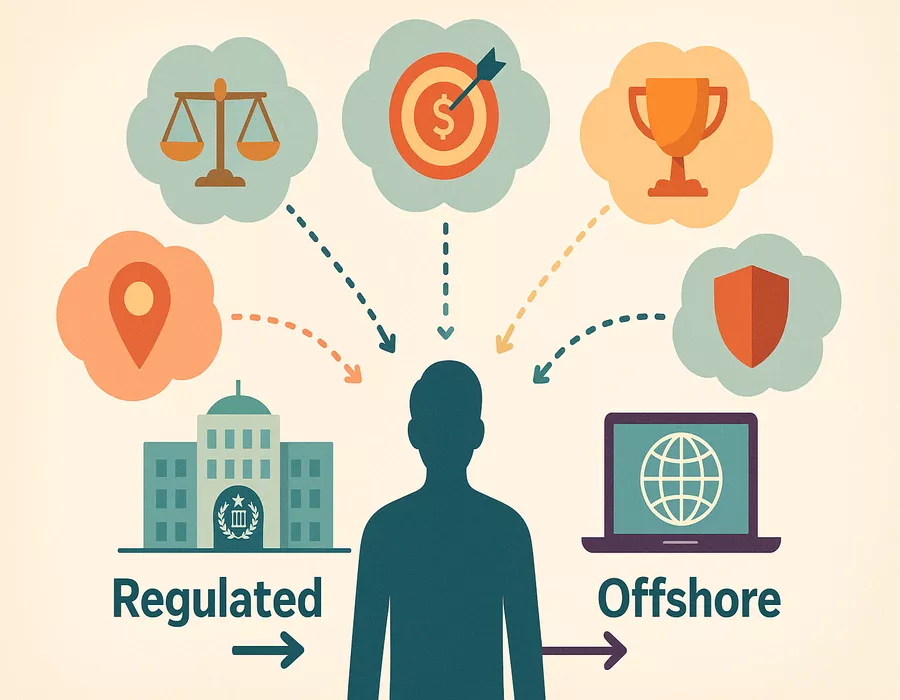
Choosing requires honest self-assessment. Define what you want from betting. Entertainment or making money? Small amounts or serious stakes?
If entertainment with modest stakes in legal jurisdictions, regulated makes sense. If serious pursuit developing skills for profit, plan for offshore because regulated books limit winners.
Research your legal environment. Know if betting is legal and offshore status. Make informed assessments.
If offshore suits your needs, prioritize established operators. Heritage Sports, Bookmaker, and Pinnacle operated decades with positive reputations. Check forums for withdrawal experiences.
Test with small deposits first. Deposit a couple hundred, bet, withdraw, see how it works. Smooth processing is positive.
Maintain multiple accounts regardless of model. This provides backups, odds shopping capability, reduces dependence on any single operator.
The choice reflects priorities: legal protection versus freedom, convenience versus value, oversight versus reputation-based trust. Neither is perfect, both have trade-offs. The right answer depends on your situation. Understanding how models differ lets you make informed decisions aligned with goals and comfort level.
